
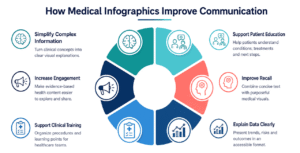
Healthcare infographics transform complicated medical information into
clear, engaging and memorable visual content. This guide explains how
hospitals, medical professionals, healthcare brands and wellness
organisations can use infographics, animation and video to educate
audiences and communicate with greater impact.
Key takeaway: Effective healthcare communication is
not only about presenting correct information. It is also about
organising that information so patients, employees and stakeholders
can understand it quickly and act on it confidently.
What Are Healthcare Infographics?
Healthcare infographics are visual representations
of medical, health or wellness information. They combine concise
text with illustrations, icons, diagrams, charts, timelines and data
visualisations to make complicated subjects easier to understand.
Their purpose is not simply to make medical content look attractive.
An effective healthcare infographic creates a clear information
hierarchy. It helps viewers identify the main message, supporting
evidence and recommended action without reading a long technical
document.
Common Elements of a Healthcare Infographic
- A clear and specific headline
- Short, patient-friendly explanations
- Relevant medical illustrations
- Icons representing symptoms, actions or risks
- Charts and graphs for healthcare statistics
- Step-by-step diagrams or timelines
- Reliable sources and medical references
- A clear call to action
Who Uses Healthcare Infographics?
Hospitals, medical clinics, pharmaceutical companies, healthcare
startups, medical-device brands, insurance providers, universities,
public-health organisations, charities and wellness businesses can
all use healthcare infographics.
They may be designed for patients, clinicians, employees, investors,
students or the general public. The terminology, visual style and
amount of technical information should always be adjusted to suit
the intended audience.
Why Healthcare Infographics Matter
Healthcare information is often technical, data-heavy and emotionally
sensitive. Patients may receive unfamiliar information while already
feeling worried or overwhelmed. Long paragraphs and complicated
terminology can make it difficult to understand the most important
instructions.
Healthcare infographics organise information into smaller visual
sections. A strong design guides the viewer from the headline to the
essential facts and finally to the recommended next step.
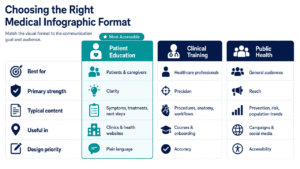
Patient Education
Explain diagnoses, medication instructions, procedures,
recovery plans and warning signs using clear visual steps.
Healthcare Marketing
Turn educational information into useful website, blog,
email and social-media content that builds trust.
Medical Training
Reinforce clinical workflows, safety instructions, onboarding
procedures and compliance requirements.
Simplifying Complex Medical Information
Medical conditions, procedures and treatments can involve terminology
unfamiliar to patients. Infographics can divide these subjects into
logical sections and connect each explanation with an appropriate
illustration.
Presenting Healthcare Data Clearly
Statistics can become difficult to interpret when they appear without
visual context. Charts, comparisons and highlighted figures help
audiences identify patterns and understand why the information
matters.
Creating Consistent Communication
Healthcare organisations often communicate through websites, social
media, presentations, training platforms and printed materials. A
consistent visual system helps maintain the same branding, tone and
messaging across every channel.
Benefits of Healthcare Infographics
Better Patient Understanding
A healthcare infographic can turn a complicated process into a clear
sequence. For example, preparation for surgery may be divided into
what to do one week before, the evening before, on the day of surgery
and during recovery.
More Memorable Communication
Visual elements create stronger associations between information and
meaning. A patient may find it easier to remember an important
medication warning when it appears beside a relevant icon or
illustration.
Flexible Use Across Multiple Platforms
One professionally designed infographic can be used in a blog article,
email campaign, social-media carousel, presentation, brochure,
downloadable guide or animated medical video.
Improved Healthcare Marketing
Educational visual content allows healthcare businesses to demonstrate
expertise without relying on aggressive promotion. A clinic can
publish useful information about symptoms or preventive care and
finish with a respectful call to action.
Stronger Internal Communication
Corporate healthcare teams can use visual summaries for employee
onboarding, compliance reminders, performance reporting, safety
procedures and internal announcements.
Support for Animation and Video
Infographic elements can become part of professional
healthcare video production. Charts can build on
screen, medical illustrations can be highlighted and icons can appear
in sequence as a narrator explains the topic.
Types of Healthcare Infographics

Patient Education Infographics
Patient education infographics explain diagnoses, treatments,
medications, recovery instructions and preventive care using clear,
accessible language.
Popular Patient Education Topics
- Understanding a diagnosis
- Preparing for a medical procedure
- Medication safety
- Managing chronic conditions
- Post-operative care
- Recognising urgent warning signs
Disease Awareness Infographics
Disease awareness infographics present symptoms, risk factors,
prevention strategies and treatment options. They are commonly used
during awareness campaigns and health observance months.
Medical Procedure Infographics
These graphics explain what happens before, during and after a medical
test, treatment or operation. Their goal is to reduce uncertainty and
help patients feel more prepared.
Medical Research Infographics
Medical research infographics summarise study objectives,
methodology, participant information, findings, conclusions and
limitations. The original research source should always be clearly
identified.
Public-Health Infographics
Public-health organisations use visual content to communicate
vaccination guidance, hygiene practices, disease prevention,
nutrition, maternal health, emergency preparedness and community
health information.
Medical Statistics Infographics
Statistics infographics present prevalence rates, survey findings,
treatment outcomes, demographic comparisons or changes over time.
Data should be presented without removing important context.
Healthcare Process Infographics
Process infographics show the order of steps in patient admission,
referrals, laboratory testing, insurance claims, discharge procedures,
telehealth appointments or clinical workflows.
Comparison Infographics
Comparison graphics help readers understand differences between
symptoms, screening methods, treatment approaches, insurance plans
or healthcare services.
Corporate Infographics for Healthcare Organisations
Corporate infographics present organisational,
financial or operational information visually. Hospitals,
pharmaceutical businesses, healthcare startups and medical technology
companies can use them to simplify internal and external business
communication.
Annual Reports
Visual reports can summarise patient numbers, growth, community
programmes, performance indicators and service improvements.
Investor Presentations
Healthcare startups can use infographics to explain market problems,
product solutions, competitive advantages, commercial models and
growth opportunities.
Employee Training and Onboarding
A visual onboarding guide can introduce company values, departmental
structures, communication procedures, safety requirements and
workplace expectations.
Medical Sales Presentations
Pharmaceutical and medical-device teams can use corporate
infographics to explain product features, clinical workflows,
supporting data and intended applications.
Wellness Infographics
Wellness infographics focus on everyday habits that
support physical, emotional or workplace wellbeing. Wellness brands,
employers and healthcare providers can use them across blogs, social
media, employee portals and downloadable guides.
Popular Wellness Infographic Topics
- Nutrition and healthy eating
- Exercise and mobility
- Hydration
- Sleep habits
- Stress management
- Mental wellbeing
- Workplace ergonomics
- Healthy screen-time habits
- Preventive health screenings
General wellness advice should not be presented as individual
medical advice. Content should be reviewed carefully and written
with suitable limitations where necessary.
Healthcare Infographics vs Healthcare Videos
Static infographics and videos serve different communication needs.
The best format depends on the complexity of the subject, the platform
and the action the audience should take.
| Content Format | Best Used For | Main Advantages | Common Platforms |
|---|---|---|---|
| Healthcare Infographic | Statistics, comparisons, instructions and quick visual summaries |
Easy to scan, save, share, print and reference | Blogs, social media, email, brochures and presentations |
| Healthcare Video | Demonstrations, interviews, storytelling and detailed explanations |
Combines narration, motion, sound and emotion | YouTube, websites, social media, training platforms |
| Animated Infographic | Explaining medical processes and statistics step by step | Makes static information more dynamic and engaging | Social media, presentations, digital signage and ads |
| Medical Presentation | Conferences, employee education, sales and investor meetings | Supports live explanation and structured discussion | Meetings, webinars, conferences and workshops |
When to Use an Infographic
- The message can be understood quickly.
- The audience may need to save or print the information.
- The content is based on statistics or comparisons.
- The visual will accompany a blog post or social update.
- The subject benefits from a one-page overview.
When to Use a Healthcare Video
- A medical process must be demonstrated.
- A doctor, patient or company representative needs to appear.
- The subject requires narration or emotional storytelling.
- Motion is important to understanding the information.
- The content will be used on YouTube or a learning platform.
Healthcare Video Production and Medical Video Production
Healthcare video production includes patient-facing,
organisational, educational, wellness and marketing content created
for healthcare businesses.
Medical video production often focuses more closely
on clinical procedures, scientific information, medical education,
pharmaceutical products and healthcare technology.
Healthcare Video Production Examples
- Hospital profile videos
- Patient testimonials
- Healthcare marketing videos
- Staff recruitment videos
- Wellness campaigns
- Training videos
- Healthcare social-media content
Medical Video Production Examples
- Medical procedure explainers
- Pharmaceutical presentations
- Medical device demonstrations
- Anatomical animations
- Clinical education videos
- Medical research summaries
- Physician training content
The Role of Healthcare Video Editing
Recording footage is only one stage of producing professional
healthcare content. Healthcare video editing turns
footage, interviews, narration, graphics and supporting visuals into
a clear and structured story.
Healthcare Video Editing May Include
- Removing mistakes and unnecessary pauses
- Improving speech clarity and audio levels
- Colour correction and visual enhancement
- Adding subtitles and accessibility captions
- Introducing speakers with professional lower thirds
- Adding medical illustrations and supporting footage
- Animating statistics, charts and diagrams
- Applying consistent branding
- Creating horizontal and vertical versions
Medical subjects require careful visual selection. Stock footage,
illustrations and statistics must support the narration rather than
introduce misleading or unrelated information.
Best Practices for Designing Healthcare Infographics
Begin With One Clear Objective
Decide what the viewer should understand or do after seeing the
infographic. Trying to include every available fact usually creates
a crowded and unfocused design.
Understand the Intended Audience
A graphic created for physicians will use different terminology from
one designed for patients, children or investors. Establish the
audience’s knowledge level before writing the copy.
Verify Medical Information
Medical facts, recommendations and statistics should be checked
against reliable and current sources. Important claims should include
clear references.
Use a Strong Visual Hierarchy
The viewer should immediately recognise:
- The main topic
- The most important message
- Supporting facts
- The recommended next step
Keep the Text Concise
An infographic should not become an article placed inside an image.
Use brief headings, meaningful labels and concise explanations.
Choose Meaningful Visuals
Icons and illustrations should explain the message. Avoid decorative
medical images that do not contribute to understanding.
Maintain Readable Typography
Use fonts that remain clear on phones, tablets and printed materials.
Avoid very small text, low contrast and too many font styles.
Use Colour Carefully
Colour can organise information and highlight warnings. However,
colour should not be the only method used to communicate meaning.
Labels, shapes and icons can improve accessibility.
Include a Clear Call to Action
The next step may encourage viewers to:
- Read the complete article
- Book an appointment
- Download a guide
- Watch a related video
- Register for a webinar
- Contact the organisation
Common Healthcare Infographic Mistakes
Including Too Much Information
Crowded designs are difficult to scan and weaken the main message.
Large topics may work better as a series of related graphics.
Using Unexplained Medical Terminology
Technical language may be appropriate for clinicians but confusing
for patients. Define essential terms and remove unnecessary jargon.
Prioritising Decoration Over Communication
Colours, illustrations and icons should support the information rather
than compete with it.
Using Unsupported Statistics
Important statistics should come from reliable sources and retain the
context required for accurate interpretation.
Poor Mobile Readability
A large percentage of viewers may see the content on a phone. Test the
design at smaller screen sizes before publishing.
Missing Brand Identity
Infographics may be shared without their original captions. Include
appropriate branding, source information and contact details within
the design.
How to Create an Effective Healthcare Infographic
Define the Communication Goal
Write one sentence explaining exactly what the infographic
must help the audience understand or do.
Identify the Audience
Consider their age, professional background, knowledge level,
concerns and preferred communication channels.
Research the Subject
Gather information from reliable sources and verify that it
remains current and relevant.
Create the Content Outline
Organise the information into a logical order, such as
problem, explanation, essential facts and recommended action.
Write Concise Copy
Convert long explanations into short, accurate statements
without removing important meaning.
Build a Wireframe
Plan the placement of headings, sections, illustrations,
statistics and calls to action before final design.
Create the Visual Design
Develop the icons, charts, illustrations, colours and branded
visual elements.
Review for Accuracy
Ask the appropriate medical or subject-matter professional to
review the information before publication.
Prepare Platform-Specific Versions
Create suitable sizes for websites, social media,
presentations, email and print.
Convert the Infographic Into Video
Animate the approved illustrations, icons and statistics to
create a narrated medical explainer or social-media video.
How to Repurpose One Healthcare Infographic
One well-researched healthcare infographic can support an entire
content campaign.
| Original Asset | Repurposed Content | Recommended Platform |
|---|---|---|
| Full healthcare infographic | Detailed educational blog article | Website and Google Search |
| Individual sections | Multi-slide social carousel | Instagram and LinkedIn |
| Main statistic | Single branded graphic | LinkedIn, Facebook and email |
| Icons and illustrations | Animated medical explainer | YouTube, website and social media |
| Educational sections | Presentation slides | Webinars, conferences and training |
| Complete visual summary | Downloadable patient guide | Email campaigns and clinic websites |
Frequently Asked Questions
What is a healthcare infographic?
A healthcare infographic is a visual explanation of
medical, health or wellness information. It uses concise
text, illustrations, icons, charts or diagrams to make
information easier to understand.
Who uses healthcare infographics?
Hospitals, clinics, pharmaceutical companies, medical
technology businesses, insurance providers, educators,
wellness brands and public-health organisations all use
healthcare infographics.
What should a medical infographic include?
It should include a clear title, accurate information,
logical visual hierarchy, readable typography, meaningful
illustrations, reliable source information and a suitable
call to action.
What are corporate infographics?
Corporate infographics present business or organisational
information visually. Healthcare companies use them for
annual reports, investor presentations, employee training,
sales material and internal communication.
What are wellness infographics?
Wellness infographics explain subjects such as nutrition,
exercise, sleep, stress management, mental wellbeing,
preventive health and healthy workplace habits.
Can healthcare infographics be animated?
Yes. Icons, illustrations, charts and written elements can
be animated and combined with voice-over, music and sound
design through professional healthcare video production.
What is healthcare video editing?
Healthcare video editing is the post-production process of
combining recorded footage, voice-over, graphics,
animation, captions and audio into a polished healthcare
video.
What is the difference between healthcare and medical video production?
Healthcare video production covers a broad range of
organisational, marketing, wellness and patient content.
Medical video production often focuses more directly on
clinical procedures, scientific information, medical
education and healthcare technology.
Why is professional infographic design important?
Professional design improves information hierarchy,
readability, visual consistency and the ability to reuse
content across websites, social media, presentations,
video and print.
Create Clearer and More Engaging Healthcare Content
I help US healthcare organizations, medical professionals, educators, and business teams turn approved information into clear visual content.
My services include healthcare infographics, corporate infographics,
wellness infographics, medical illustrations, healthcare video
production, medical video production, healthcare video editing,
animated explainers, patient education videos and medical
presentations.
This article provides general information about healthcare visual
communication and is not intended to replace professional medical advice.